CLR 121225

(CLR 225): Alpha Emitter (225Ac)

An investigational targeted radioconjugate designed to deliver potent alpha-emitting radiation for the treatment of solid tumors.

Program Overview

CLR 225 is an investigational phospholipid ether (PLE) radioconjugate designed to deliver actinium-225 (225Ac), a potent alpha-emitting isotope, directly into cancer cells.

This approach leverages Cellectar’s proprietary PLE platform to selectively target tumor cell membranes, enabling localized delivery of cytotoxic radiation while sparing normal tissue.

Key Points

  • Targets cancer cells through PLE-mediated uptake
  • Delivers high-linear-energy-transfer (LET) alpha emissions for potent localized cell killing
  • Designed to minimize collateral tissue damage due to short-range emission (< 100 μm)
  • Structurally consistent with iopofosine I-131, supporting development efficiency

Mechanism of Action

How Alpha Emitters Work

Alpha emitters release high-energy helium nuclei that create dense ionization tracks within a few cell diameters, producing double-strand DNA breaks and rapid, irreversible cell death.

CLR 225 uses Cellectar’s PLE targeting to internalize these alpha emissions directly within tumor cells, concentrating the therapeutic effect precisely at the disease site.

Scientific Highlights

  • Double-strand DNA damage via high-LET alpha particles
  • Intracellular delivery limits radiation exposure to healthy cells
  • Designed for deep tumor penetration with controlled toxicity profile

Preclinical Efficacy

Tumor Volume Reduction and Survival Benefit in Pancreatic Cancer

In preclinical pancreatic cancer models, CLR 225 produced a clear, dose-dependent reduction in tumor volume and extended survival across all tested groups.

The compound was well tolerated at every evaluated dose, demonstrating both potent antitumor activity and a favorable safety profile.

Key Findings

  • Tested in three xenograft models (MIA PaCa-2, PANC-1, BxPC-3)
  • Dose-response pattern consistent across all models (Cold, 100 nCi, 250 nCi, 500 nCi)
  • Tumor volume reduction and improved survival observed at every dose
  • No dose-limiting toxicities detected
Tumor Reduction icon

Tumor Reduction

Survival Benefit icon

Survival Benefit

Tolerated Doses icon

Tolerated Doses

Biodistribution

High and Prolonged Tumor Uptake with Low Normal Tissue Uptake

CLR 225 demonstrated selective tumor accumulation and retention in preclinical pancreatic models, with minimal uptake in non-target organs.

Highlights

  • Sustained tumor uptake > 144 hours
  • Minimal uptake in critical normal tissues (liver, kidney, heart)
  • Favorable tumor-to-blood ratio supporting targeted delivery
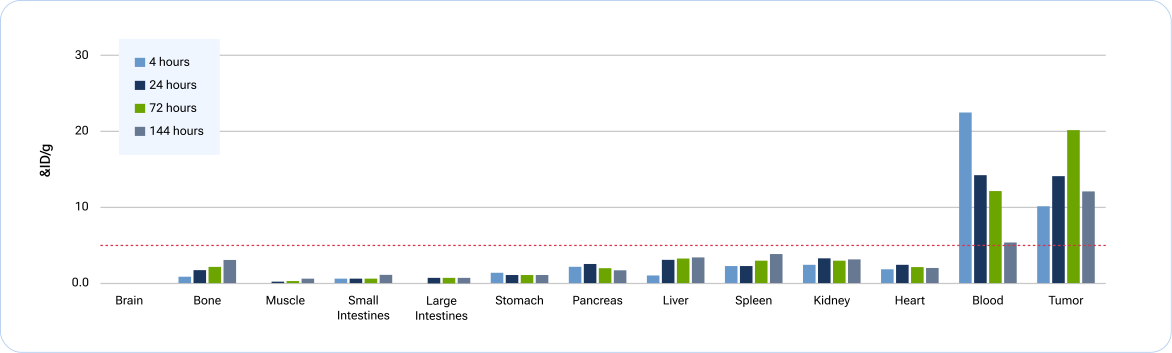
The chart displays percent injected dose per gram of tissue for CLR 225 at 4, 24, 72, and 144 hours post-injection in a pancreatic cancer model. Tumor uptake remains high and sustained through 144 hours, while uptake in normal tissues such as liver, spleen, kidney, and heart remains low. The data indicate favorable tumor selectivity and prolonged retention, supporting targeted delivery and minimal off-target radiation.

High and prolonged tumor uptake; low normal tissue uptake

Clinical Evaluation

Phase 1 Imaging and Therapy Study in Pancreatic Cancer

We plan to evaluate CLR 225 in a Phase 1 clinical study to assess safety, biodistribution, and dose-limiting toxicities using an accelerated titration design.

Study Overview

  • Imaging and therapy study
  • Accelerated intrapatient dose escalation for early determination of tolerability
  • Dose-limiting toxicities assessed post-Cycle 1 Day 57
  • Standard 3+3 escalation following initial titration

Excellent labeling efficiency with 225Ac

Simplified reaction process icon

Simplified reaction process

Preferred formulation for toxicity studies icon

Preferred formulation for toxicity studies (no polysorbate needed)

Phase 1 study design

Imaging and therapy study icon

Imaging and therapy study

Dose escalation utilizing an accelerated titration design icon

Dose escalation utilizing an accelerated titration design (allows intrapatient dose escalation for more rapid dose escalation); dose limiting toxicities to be assessed post-cycle 1 day 57

Dose escalations icon

Dose escalations = 40% increases until first moderate toxicity; then standard 3+3 escalation

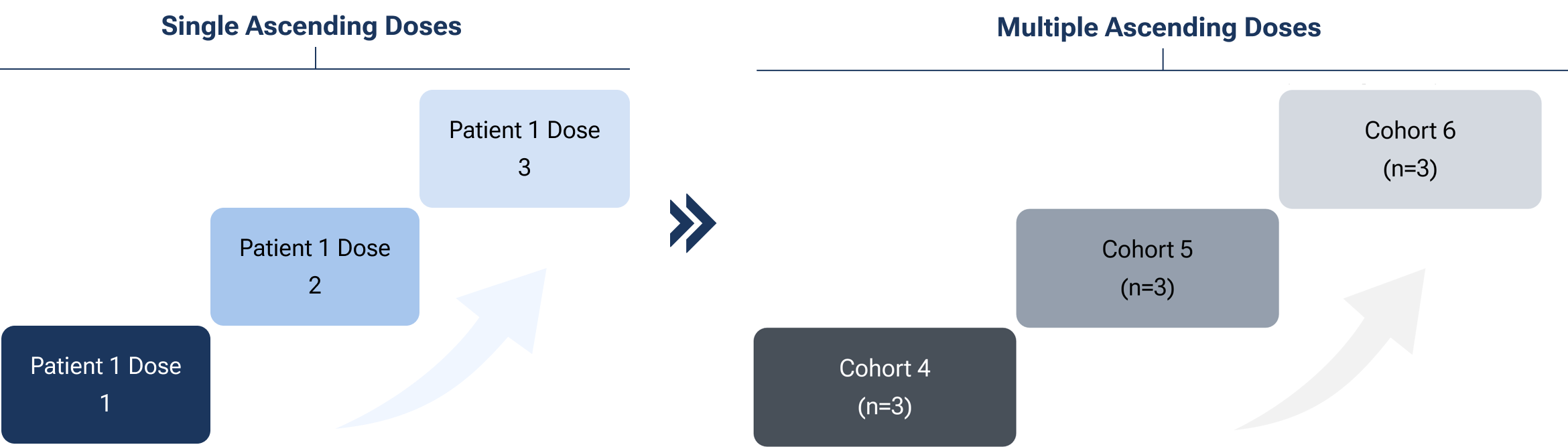
Single Ascending Doses and Multiple Ascending Doses

The clinical design and formulation advantages for CLR 121225, a targeted alpha radioconjugate using actinium-225.

The left panel highlights formulation and labeling advantages — CLR 225 can be produced through a simplified reaction process and uses a preferred formulation that eliminates the need for polysorbate (a stabilizing agent often required for toxicity studies). This supports manufacturing efficiency and cleaner safety evaluation.

The right panel explains the Phase 1 study design, which is both an imaging and therapy study. The trial uses an accelerated titration design, allowing dose escalation within the same patient to reach effective dose levels more rapidly. Dose-limiting toxicities are assessed after the first treatment cycle (Day 57). Once moderate toxicity is observed, the design transitions to a traditional 3+3 cohort escalation model — a standard oncology trial structure for determining safe dosing.

The bottom schematic visualizes this approach:

Single Ascending Doses (Patient 1 Doses 1–3): The same patient receives increasing doses in sequence.


Multiple Ascending Doses (Cohorts 4–6): Once initial tolerability is confirmed, small patient groups (three per cohort) receive escalating dose levels.

Overall, this study design enables faster identification of the recommended clinical dose while maintaining safety oversight.

Development Pathway

Extending the PDC Platform with Alpha Emitters

CLR 225 represents Cellectar’s continued expansion into high-LET alpha therapeutics, complementing beta- and Auger-based programs in development.

Compliance Statement

  • CLR 225 is an investigational agent and has not been approved by the U.S. Food and Drug Administration or any other regulatory authority.